Audio Visual Presentations
2026
Oct
IV IPSPA Symposium – SDCP
Beyond Growth: Rewiring Society 6.0 through Circular Wisdom and Sustainable Governance
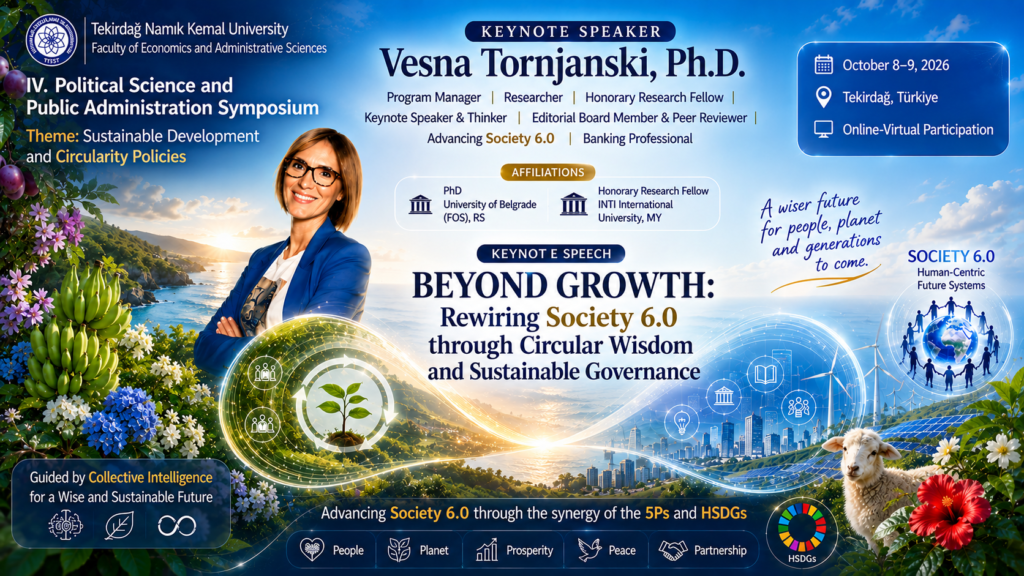
🎓 Title: Beyond Growth: Rewiring Society 6.0 through Circular Wisdom and Sustainable Governance
🌍 KEYNOTE ADDRESS | IV IPSPA SYMPOSIUM 2026
Beyond Growth: Rewiring Society 6.0 through Circular Wisdom and Sustainable Governance
🎤 Keynote Speaker: Vesna Tornjanski 🇷🇸 🇲🇾
🏛️ Event: IV International Political Science and Public Administration Symposium
📅 Date: October 8–9, 2026
📌 Format: Online Program
♻️ Conference Theme: Sustainable Development and Circularity Policies
🎓 Host Institution: Faculty of Economics and Administrative Sciences, Department of Political Science and Public Administration, Tekirdağ Namık Kemal University, Türkiye 🇹🇷
🔎 Keynote Focus
This keynote explores how Society 6.0 can be reimagined beyond conventional growth paradigms through circular wisdom, sustainable governance, and human-centered societal transformation.
It advances a systemic perspective on aligning technological progress, ecological responsibility, institutional innovation, and collective well-being. At its heart is a call for structural alignment between the HSDGs, and the UN 5Ps: People, Planet, Prosperity, Peace, and Partnership, across every level of society, from global and national governance to organizations, communities, and individuals.
🌐 Five Strategic Pillars
♻️ Circular Wisdom — redefining value creation through resource stewardship, regeneration, and responsible consumption.
🌱 Beyond Growth — broadening progress beyond conventional economic measures to encompass ecological integrity, social well-being, and long-term prosperity.
🏛️ Sustainable Governance — embedding policy coherence, institutional accountability, and adaptive decision-making into governance systems.
🤝 Structural Alignment Across Society — translating the SDGs, HSDGs, and 5Ps into mutually reinforcing priorities, responsibilities, policies, organizational strategies, and individual actions.
🔭 Human-Centered Society 6.0 — aligning technological innovation with human values, planetary boundaries, and intergenerational responsibility.
🎯 Key Messages
🌍 Align the SDGs and HSDGs structurally with the 5Ps to connect global sustainability commitments with national strategies, institutional mandates, organizational practices, community initiatives, and individual responsibility.
🔄 Embed circularity into governance and economic systems as a cross-cutting principle of resource management, value creation, and regenerative development.
🏛️ Strengthen multilevel governance and policy coherence by connecting objectives, decision-making, implementation, accountability, and measurable outcomes across sectors and levels of society.
🤝 Operationalize the 5Ps: People, Planet, Prosperity, Peace, and Partnership as an integrated framework for aligning social, environmental, economic, institutional, and collaborative priorities.
💡 Place human values at the center of technological transformation, ensuring that Society 6.0 advances inclusive innovation and collective well-being.
🌱 Institutionalize intergenerational responsibility by connecting present decisions with the long-term resilience and flourishing of future generations.
🎓 Strategic Significance and Policy Implications
The keynote calls for a transition from fragmented sustainability initiatives toward structurally aligned, multilevel, and whole-of-society governance. It emphasizes that the SDGs, HSDGs, and 5Ps should not operate as separate agendas, but as interconnected reference points for policy formulation, institutional design, organizational governance, and individual action.
This approach requires vertical alignment between global commitments, national policies, local implementation, organizational objectives, and individual practices, supported by horizontal coordination across sectors, institutions, and society.
Within this architecture, circular wisdom provides a guiding principle for resource stewardship and regenerative value creation, while sustainable governance provides the institutional mechanisms for coordination, accountability, adaptation, and long-term impact.
The central proposition is that Society 6.0 requires more than sustainable technologies and isolated policy reforms: it requires a coherent architecture of shared purpose, aligned responsibilities, and mutually reinforcing action across all levels of society.
✨ Beyond growth. Beyond fragmentation. Towards structurally aligned SDGs, HSDGs, and 5Ps for a circular, regenerative, and human-centered Society 6.0.
#KeynoteSpeech #Society60 #SDGs #HSDGs #The5Ps #CircularWisdom #SustainableGovernance #PolicyCoherence #WholeOfSociety #MultilevelGovernance #BeyondGrowth #IVIPSPASymposium
2026
Oct
IV IPSPA Symposium – SDCP
Anticipatory Multi-Level Governance for Circular and Sustainable Societies: Resource Policy Transformation in Society 6.0
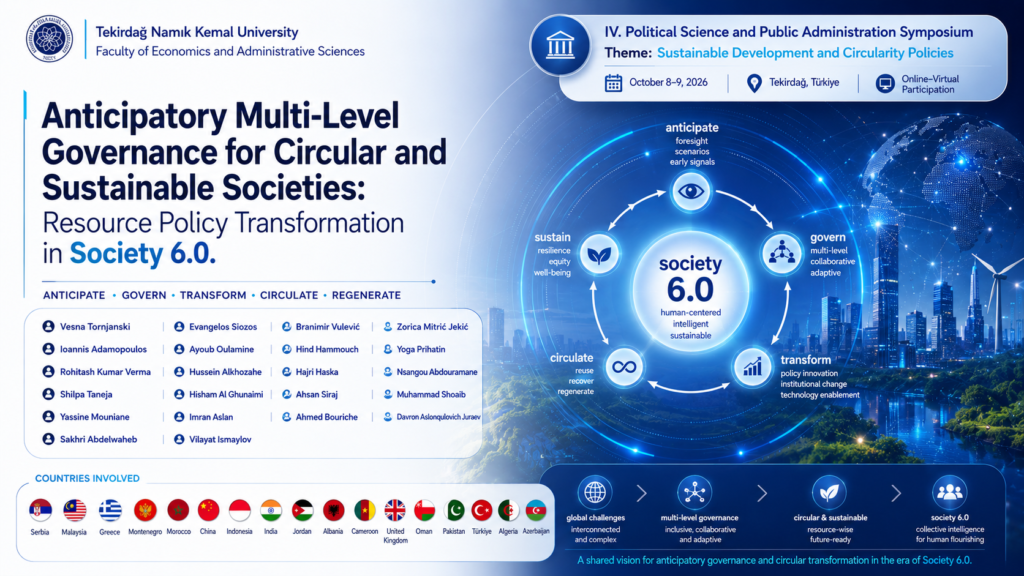
🎓 Title: Anticipatory Multi-Level Governance for Circular and Sustainable Societies: Resource Policy Transformation in Society 6.0
🌍 RESEARCH PRESENTATION | INTERNATIONAL SYMPOSIUM 2026
🎤 Speaker: Vesna Tornjanski 🇷🇸 🇲🇾
👥 Authors:
Vesna Tornjanski — 🇷🇸 Serbia / 🇲🇾 Malaysia
Evangelos Siozos — 🇬🇷 Greece
Branimir Vulević — 🇷🇸 Serbia / 🇲🇪 Montenegro
Zorica Mitrić Jekić — 🇷🇸 Serbia
Ioannis Adamopoulos — 🇬🇷 Greece
Ayoub Oulamine — 🇲🇦 Morocco
Hind Hammouch — 🇲🇦 Morocco / 🇨🇳 China
Yoga Prihatin — 🇮🇩 Indonesia
Rohitash Kumar Verma — 🇮🇳 India / 🇲🇾 Malaysia
Hussein Alkhozahe — 🇯🇴 Jordan
Hajri Haska — 🇦🇱 Albania
Nsangou Abdouramane — 🇨🇲 Cameroon
Shilpa Taneja — 🇬🇧 United Kingdom
Hisham Al Ghunaimi — 🇴🇲 Oman
Ahsan Siraj — 🇨🇳 China / 🇵🇰 Pakistan
Muhammad Shoaib — 🇵🇰 Pakistan
Yassine Mouniane — 🇲🇦 Morocco
Imran Aslan — 🇹🇷 Türkiye
Ahmed Bouriche — 🇩🇿 Algeria
Davron Aslonqulovich Juraev — 🇦🇿 Azerbaijan
Sakhri Abdelwaheb — 🇩🇿 Algeria
Vilayat Ismaylov — 🇦🇿 Azerbaijan
🏛️ Conference: IV International Political Science and Public Administration Symposium - Online Program
📅 Date: October 8–9, 2026
📌 Presentation Day: Day 1 - October 8, 2026
♻️ Conference Theme: Sustainable Development and Circularity Policies
🎓 Host Institution: Tekirdağ Namık Kemal University, Faculty of Economics and Administrative Sciences, Department of Political Science and Public Administration.
🔎 Research Focus
This presentation proposes an Anticipatory Multi-Level Governance Framework for advancing circular and sustainable societies in the era of Society 6.0. It examines how governments and institutions can move beyond reactive crisis management toward proactive, coordinated, and adaptive resource policymaking.
Drawing on a systematic literature review and structured evidence synthesis, the study integrates anticipatory governance, circular economy principles, sustainability transitions, and strategic resource policy into a unified conceptual architecture.
🌐 Five Governance Priorities
🔭 Anticipatory Governance — identifying emerging risks and preparing for long-term societal challenges.
♻️ Strategic Resource Prioritization — supporting responsible resource allocation across food, energy, water, infrastructure, and ecosystems.
🏛️ Multi-Level Policy Coordination — aligning institutions, governance levels, and sectoral priorities.
🤝 Inclusive and Participatory Policymaking — integrating stakeholder knowledge and societal needs into policy design.
💻 Digital and Adaptive Governance — strengthening institutional learning, evidence-informed decisions, and responsiveness to change.
🎯 Key Policy Messages
🔭 Shift from reactive crisis management to anticipatory policymaking through foresight, risk awareness, and long-term planning.
♻️ Integrate circularity across critical resource systems rather than relying solely on isolated sector-specific interventions.
🏛️ Strengthen coordination across governance levels to improve policy coherence and implementation capacity.
🤝 Combine institutional adaptability with inclusive participation to support equitable and resilient sustainability transitions.
🌍 Align resource governance with the UN 5Ps and HSDGs, connecting people, environmental protection, prosperity, peace, partnerships, and broader sustainable development objectives.
🎓 Academic Contributions and Policy Implications
This conceptual study advances an integrated governance architecture connecting anticipatory governance, strategic resource prioritization, and multi-level circularity. Its principal contribution is to bridge governance and circular economy research through a cross-sectoral framework designed to support proactive, inclusive, and resilient sustainability transitions.
The proposed framework provides policymakers and public institutions a conceptual foundation for coordinating resource policies across sectors and governance levels while accommodating different institutional capacities and societal needs. Future empirical research can assess its applicability across diverse policy environments.
✨ Transforming resource governance through anticipation, circularity, institutional coordination, and long-term societal resilience.
#Society60 #AnticipatoryGovernance #MultiLevelGovernance #CircularEconomy #ResourcePolicy #SustainableDevelopment #PolicyInnovation #Resilience #IVIPSPASymposium
2026
Oct
IV IPSPA Symposium – SDCP
Rethinking sustainability and circularity policymaking through the Society 6.0 framework: Towards participatory and adaptive governance for future generations
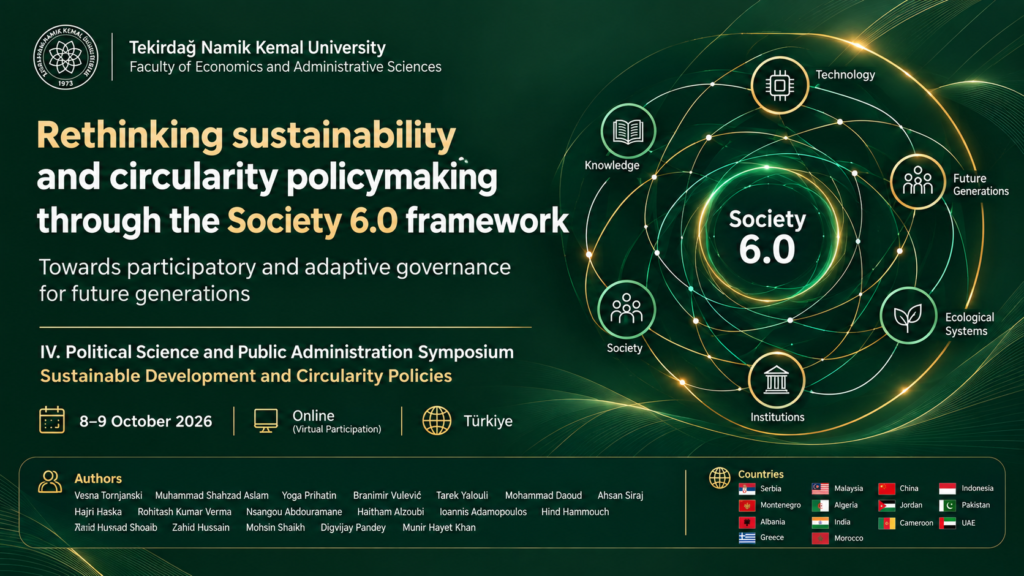
🎓 Title: Rethinking sustainability and circularity policymaking through the Society 6.0 framework: Towards participatory and adaptive governance for future generations
🌍 RESEARCH PRESENTATION | INTERNATIONAL SYMPOSIUM 2026
🎤 Speaker: Vesna Tornjanski 🇷🇸 🇲🇾
👥 Authors:
Vesna Tornjanski — 🇷🇸 Serbia / 🇲🇾 Malaysia
Muhammad Shahzad Aslam — 🇲🇾 Malaysia / 🇨🇳 China
Yoga Prihatin — 🇮🇩 Indonesia
Branimir Vulević — 🇷🇸 Serbia / 🇲🇪 Montenegro
Tarek Yalouli — 🇩🇿 Algeria
Mohammad Daoud — 🇯🇴 Jordan
Ahsan Siraj — 🇨🇳 China / 🇵🇰 Pakistan
Hajri Haska — 🇦🇱 Albania
Rohitash Kumar Verma — 🇮🇳 India / 🇲🇾 Malaysia
Nsangou Abdouramane — 🇨🇲 Cameroon
Haitham Alzoubi — 🇦🇪 United Arab Emirates
Ioannis Adamopoulos — 🇬🇷 Greece
Hind Hammouch — 🇲🇦 Morocco / 🇨🇳 China
Muhammad Shoaib — 🇵🇰 Pakistan
Zahid Hussain — 🇵🇰 Pakistan
Mohsin Shaikh — 🇮🇳 India
Digvijay Pandey — 🇮🇳 India
Munir Hayet Khan — 🇲🇾 Malaysia
🏛️ Conference: IV International Political Science and Public Administration Symposium - Online Program
📅 Date: October 8–9, 2026
📌 Presentation Day: Day 1 — October 8, 2026
♻️ Conference Theme: Sustainable Development and Circularity Policies
🎓 Host Institution: Tekirdağ Namık Kemal University, Faculty of Economics and Administrative Sciences, Department of Political Science and Public Administration.
🔎 Research Focus
This presentation explores how the Society 6.0 framework can reshape sustainability and circularity policymaking through participatory, adaptive, and future-oriented governance. It positions sustainability not merely as a policy target, but as an ongoing societal process requiring collaboration, institutional learning, and shared responsibility.
The study synthesizes multidisciplinary research to develop an integrated conceptual perspective on governance systems capable of responding to environmental pressures, technological disruption, socioeconomic inequalities, and long-term societal uncertainty.
🌐 Six Governance Priorities
🤝 Participatory Governance — engaging governments, academia, businesses, civil society, and citizens in shared decision-making.
🔄 Adaptive Institutions — enabling continuous policy learning, evaluation, and adjustment.
📊 Evidence-Informed Policymaking — grounding decisions in multidisciplinary knowledge and systematic assessment.
🧠 Collective Intelligence — integrating diverse expertise and societal perspectives into policy design.
🔭 Anticipatory Governance — incorporating foresight and long-term thinking into decisions affecting future generations.
🌱 Systemic Policy Coherence — connecting sustainability and circularity objectives across sectors and levels of governance.
🎯 Key Policy Messages
🏛️ Move beyond isolated, top-down interventions toward open, collaborative governance ecosystems.
🤝 Institutionalize meaningful stakeholder participation and shared responsibility across public and private sectors and civil society.
🔄 Strengthen adaptive policymaking through continuous learning, evaluation, and evidence-based adjustment.
🔭 Integrate long-term foresight and intergenerational accountability into sustainability and circularity strategies.
🌍 Align environmental, social, economic, and technological priorities within coherent, inclusive, and regenerative policy systems.
🎓 Academic Contributions and Policy Implications
This conceptual study positions Society 6.0 as an integrative perspective connecting adaptive governance, systems thinking, participatory decision-making, and long-term societal resilience. It provides a theoretical foundation for developing more inclusive, responsive, and future-oriented sustainability and circularity policies.
Its central contribution is to conceptualize governance as a continuous process of societal co-creation, evaluation, and institutional adaptation, with implications for policymakers, public institutions, businesses, researchers, and civil society. Future research can further operationalize and empirically validate the proposed governance perspective across diverse policy contexts.
✨ Shaping resilient, inclusive, and regenerative societies through participatory governance, adaptive policymaking, and intergenerational responsibility.
#Society60 #SustainableDevelopment #CircularEconomy #AdaptiveGovernance #ParticipatoryGovernance #PublicPolicy #FutureGenerations #CircularityPolicies #IVIPSPASymposium
2026
Oct
IV IPSPA Symposium – SDCP
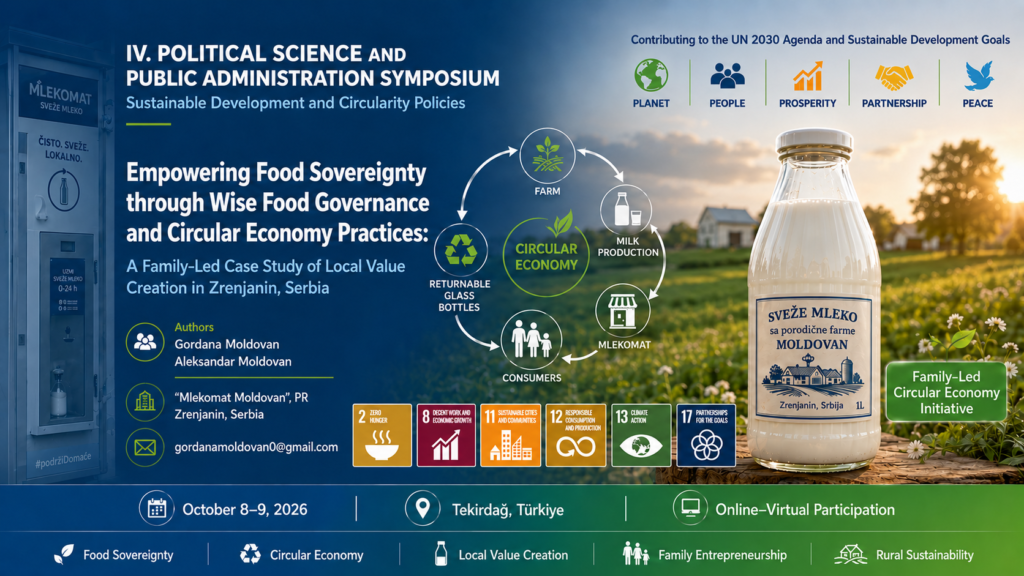
Empowering Food Sovereignty through Wise Food Governance and Circular Economy Practices: A Family-Led Case Study of Local Value Creation in Zrenjanin, Serbia
2026
Oct
IV IPSPA Symposium – SDCP
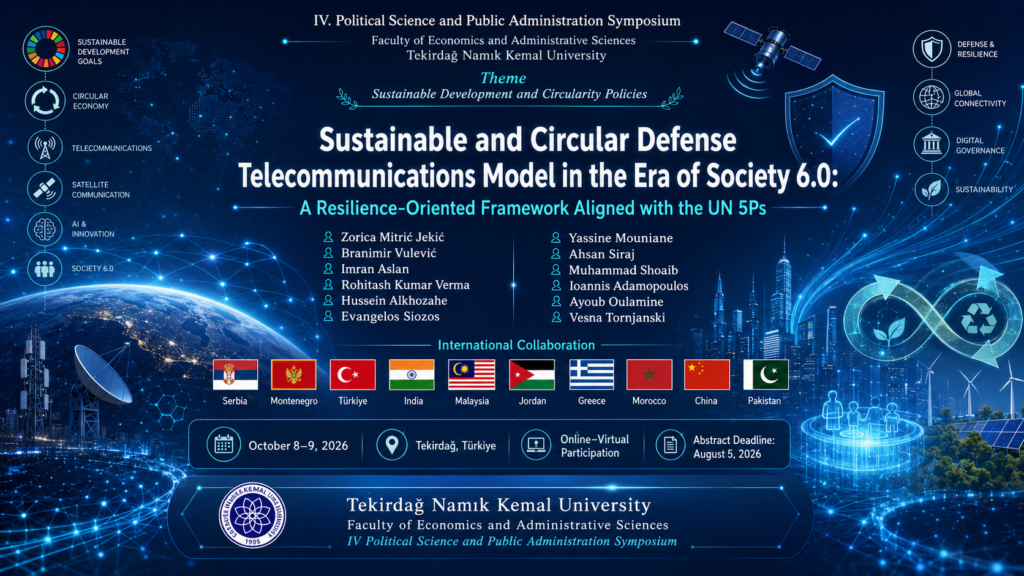
Sustainable and Circular Defense Telecommunications Model in the Era of Society 6.0: A Resilience-Oriented Framework Aligned with the UN 5Ps
2026
Oct
IV IPSPA Symposium – SDCP
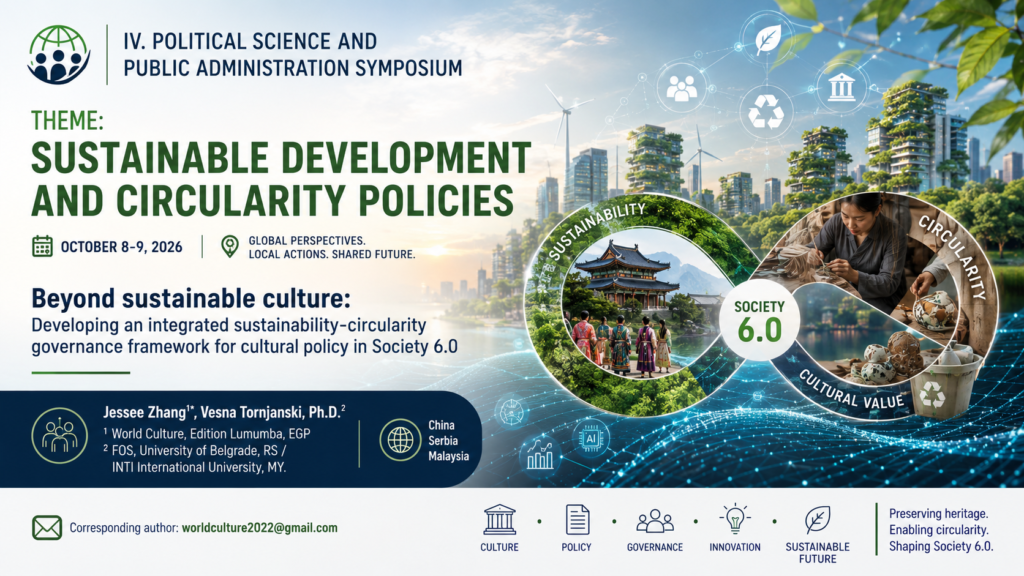
Beyond Sustainable Culture: Developing an Integrated Sustainability-Circularity Governance Framework for Cultural Policy in Society 6.0
2026
May
FIRST IS-SDRP21C
Society 6: Designing Sustainability & Resource Policy for a Thriving Civilization

2026
May
FIRST IS-SDRP21C
Society 6.0: From Crisis Response to Multi-Level, Anticipatory Governance through Holistic and Priority-Driven Resource Policy in the 21st Century and Beyond

2026
May
FIRST IS-SDRP21C
Society 6: A Multi-Level Adaptive Sustainability Model for Regenerative and Enduring Societal Systems

2026
May
FIRST IS-SDRP21C
Toward a holistic collective evolutionary defense framework: Integrated telecommunications ecosystem for Society 6.0

🎓 Title: Toward a holistic collective evolutionary defense framework: Integrated telecommunications ecosystem for Society 6.0
🌐⚡ As humanity enters an era of hyperconnectivity, autonomous intelligence, and multidomain complexity, the future of defense communications demands more than modernization - it demands evolution.
🎤 Speaker: Zorica Mitrić Jekić
📖 Toward a Holistic Collective Evolutionary Defense Framework:
Integrated Telecommunications Ecosystem for Society 6.0
🌍 An international collaborative research initiative bringing together experts from:
🇷🇸 Serbia | 🇲🇪 Montenegro | 🇹🇷 Türkiye | 🇮🇳 India | 🇲🇾 Malaysia | 🇯🇴 Jordan | 🇬🇷 Greece | 🇲🇦 Morocco | 🇨🇳 China | 🇵🇰 Pakistan
👥 International Research Team:
Zorica Mitrić Jekić, Branimir Vulević, Imran Aslan, Rohitash Kumar Verma, Hussein Alkhozahe, Evangelos Siozos, Yassine Mouniane, Ahsan Siraj, Muhammad Shoaib, Ioannis Adamopoulos, Ayoub Oulamine, and Vesna Tornjanski
🚀 This research introduces the original concept of Society 6.0 - a holistic, adaptive, and sustainability-oriented telecommunications ecosystem designed for future multidomain defense environments.
💡 The study explores how emerging technologies can transform defense telecommunications through:
🤖 AI-native networking & autonomous decision-making
🔐 Zero-trust governance & post-quantum security
📡 6G ultra-low-latency communications
🛰️ Hybrid terrestrial, non-terrestrial & space-integrated networks
⚙️ Adaptive cyber-electromagnetic spectrum cognition
🌱 Sustainability, resilience & ethical technological co-design
🔍 Moving beyond fragmented legacy infrastructures, the framework reconceptualizes telecommunications as an ecosystem-centric architecture aligned with the UN 5Ps principles:
👥 People | 🌍 Planet | 📈 Prosperity | ☮️ Peace | 🤝 Partnership
⚡ By integrating distributed intelligence, cryptographic agility, autonomous systems, and sustainability-driven innovation, Society 6.0 positions telecommunications infrastructures not only as operational defense assets - but as strategic instruments of global resilience, cooperative security, and societal thriving.
🌌 A visionary pathway toward future-ready communications ecosystems for an interconnected world.
#Society6 #Telecommunications #DefenseInnovation #6G #ArtificialIntelligence #CyberSecurity #PostQuantum #Sustainability #DigitalTransformation #FutureNetworks #GlobalSecurity #InnovationEcosystem #Resilience #SpaceCommunications #ResearchPresentation
2026
May
FIRST IS-SDRP21C
Digital Media and Cultural Identity in Globalized Societies: A Critical Literature Review on Strategies for Cultural Preservation

🎓 Title: Digital Media and Cultural Identity in Globalized Societies: A Critical Literature Review on Strategies for Cultural Preservation
🌍✨ Where digital media reshapes the world, cultural identity faces both transformation and survival.
🎤 Speaker: Jessee Zhang
Presented at the First International Symposium on Sustainable Development and Resource Policies in the 21st Century📍 Turkey | May 20–21, 2026
📖 Digital Media and Cultural Identity in Globalized Societies:
A Critical Literature Review on Strategies for Cultural Preservation
👤 First Author & Contact:
Jessee Zhang
🌐 World Culture | Edition Lumumba | EGP
📧 worldculture2022@gmail.com
🎓 Co-Author:
Vesna Tornjanski, Ph.D.
🏛️ Faculty of Organizational Sciences, University of Belgrade, Serbia
🌏 INTI International University, Malaysia
📧 vtornjanski@gmail.com
📧 contact@vesnatornjanski.com
🌐 vesnatornjanski.com
💡 This research examines the interplay between digital media and cultural identity through theoretical frameworks, interdisciplinary scholarship, and empirical findings focused on cultural continuity in globalized societies.
🔍 The study explores mechanisms that support:
🗣️ Cultural identity & linguistic continuity
📚 Online heritage preservation
🎞️ Digital storytelling
🌐 Platform-mediated cultural initiatives
🤝 Intercultural dialogue in networked environments
⚡ By synthesizing contemporary research, the paper reveals both the challenges and opportunities of preserving cultural diversity in rapidly evolving digital landscapes - highlighting how communities negotiate, protect, and reimagine identity in the digital age.
#DigitalCulture #CulturalIdentity #DigitalMedia #Globalization #CulturalPreservation #DigitalStorytelling #ResearchPresentation
2025
October
3rd IPS&PAS
Keynote speech

🌐 Keynote: Just Governance in the Digital Transformation Era
🎤 Speaker: Vesna Tornjanski, Ph.D.
🏛️ Host: Tekirdağ Namık Kemal University, Türkiye
🌍 Conference: 3rd International Political Science and Public Administration Symposium 2025
📅 Date: October 22, 2025
In this thoughtful keynote, we reflect on how digital technologies are shaping governance and public life, and how they can best serve people.
Emphasising the growing partnership between Serbia and Turkey, the speech highlights the value of collaboration, justice, and sustainable development in a world that is constantly evolving.
Key Messages:
Technology as a Tool, Not an End: Digital innovation can support fairness, accountability, and human dignity.
Transparency: Citizens must understand how their data is used and how decisions are made.
Inclusivity: Bridging the digital divide helps ensure everyone has equal access, regardless of age, gender, or income.
Ethics: Digital systems should uphold human dignity and avoid causing harm.
Participation: Encouraging civic engagement empowers communities and strengthens democracy.
Shared Responsibility: Governments, academics, technologists, and civil society can work together to build adaptive, just, and inclusive governance.
This keynote gently invites all stakeholders to explore the opportunities of the digital era and to help shape systems that are fair, resilient, and empowering for all.
Vesna Tornjanski, Ph.D.
Serbia
2025
October
3rd IPS&PAS
Just Governance for Society 6.0 – Awakening Human-Centric Wisdom for a Flourishing World

🎓 Title: Just Governance for Society 6.0: Awakening Human-Centric Wisdom for a Flourishing World
🔍 Overview
In an era defined by smart technologies, global interdependence, and accelerating change, a new vision of governance is taking shape, one grounded in justice, ethics, and human values.
This video presents groundbreaking international research on Just Governance in Society 6.0, developed by scholars from Serbia, Morocco, India, China, Greece, Algeria, and Pakistan, with contributions from researchers and practitioners worldwide.
Society 6.0 represents the next evolutionary stage of human civilization, a Collective Evolutionary Ecosystem where humans and intelligent systems co-create sustainable, inclusive, and wise societies. Within this paradigm, Just Governance provides the ethical and structural foundation to align political, economic, social, and technological progress with fairness, transparency, accountability, and intergenerational responsibility.
🌍 Core Vision
Governance is reimagined as a human-centric covenant, not merely an administrative mechanism, but a living, participatory, and incorruptible ecosystem that nurtures justice, equity, and harmony across generations.
The framework integrates the five pillars of human sustainability (5Ps):
People, Planet, Prosperity, Peace, and Partnership, forming the foundation of the Humanity’s Sustainable Development Goals (HSDGs).
⚙️ Research Framework & Methodology
This study employs a unique, integrated methodology combining:
Beckhard and Harris’s transformation model – for systemic change;
PRISMA – for comprehensive research synthesis;
The Five-Stage Method – for conceptual innovation and model development.
These approaches construct an integrated and dynamic governance framework capable of addressing contemporary challenges, including inequality, fragmentation, and social, economic, and ecological imbalances.
💡 Key Insights
The research introduces a paradigm shift, from bureaucratic, hierarchical governance toward an evolutionary, participatory, and ethically driven system rooted in Collective Harmony.
The proposed model integrates six complementary intelligences:
Human, Smart Machine, Ecological, Cultural, Ethical/Spiritual, and Collective, operating within a continuous data–knowledge–intelligence–wisdom–action cycle that fuels sustainable and just societal evolution.
👩💼 Authors
Vesna Tornjanski, Ph.D.
Faculty of Organizational Sciences, University of Belgrade, Serbia / INTI International University, Malaysia
📧 vtornjanski@gmail.com | contact@vesnatornjanski.com
🌐 vesnatornjanski.com | ORCID
Yassine Mouniane, Ph.D. Candidate
Natural Resources and Sustainable Development Laboratory, Faculty of Sciences, Ibn Tofail University, Kenitra, Morocco
📧 yassine.mouniane@uit.ac.ma | ORCID
Rohitash Kumar Verma, Ph.D.
University of Rajasthan, India / INTI International University, Malaysia
📧 rohittash7@gmail.com | ORCID
Ahsan Siraj, Ph.D.
School of Management, Zhengzhou University, China
📧 ahsan.sehar4@gmail.com | ORCID
Ioannis Adamopoulos, Ph.D.
Department of Public Health Policy, University of West Attica, Athens, Greece
📧 adamopoul@gmail.com | adamopoulos.ioannis@ac.eap.gr | ORCID
Ahmed Bouriche, DBA
University Centre of Maghnia, Algeria
📧 a.bouriche@cu-maghnia.dz | ORCID
Mohsin Shaikh, Ph.D.
School of Business, Dr. Vishwanath Karad MIT World Peace University, Pune, India
📧 mohsin.shaikh@mitwpu.edu.in | ORCID
Zahid Hussain, Ph.D.
Khadim Ali Shah Bukhari Institute of Technology (KASBIT), Karachi, Pakistan
📧 Zahidhussain9341@gmail.com | ORCID
🌟 Join Us in Shaping the Future of Just Governance
Together, we stand at the threshold of a new civilization - one where wisdom, compassion, and collective intelligence guide humanity’s healthy development.
Join this global movement toward Society 6.0, where governance transcends bureaucracy and becomes a living embodiment of justice, ethics, and shared prosperity.
💫 Be part of the awakening - co-create a flourishing world rooted in fairness, harmony, and human dignity.

The Team.
2025
August
ICETSD2025
Empowering the Future: Society 6.0 – The Collective Evolutionary Ecosystem for HSDG-Driven Management, Innovation, Technology, and Engineering Worldwide

Abstract
Objective and purpose:
This study aims to enhance Humanity’s Sustainable Development Goals (hereafter: HSDGs) by introducing a groundbreaking conceptual framework that merges the Society 5.0 and Collective Intelligence (Hybrid) Ecosystem. The purpose is to shape a future where human-centric values and healthy development are at the core of society’s prosperous evolution, redefining the equilibrium between technological progress and the preservation of humanity, viewed through the lens of HSDG-driven management, innovation, technology and engineering worldwide.
Research methods:
The research sparks a dynamic mixed-methods approach, blending Beckhard and Harris’ basic change components into the article’s structure, and integrating the “Prisma” and “Five-Stage” research methods, to construct a holistic, bold and reliable pattern that addresses global challenges and proposes strategic solutions.
Research results:
This study introduces a new societal model, Society 6.0: The Collective Evolutionary Ecosystem. This model emerges from the integration of the most effective elements of Society 5.0 and the Collective Intelligence (Hybrid) Ecosystem, paving the way for a people-focused, healthy, and resilient future that is adaptable to developed, developing, and underdeveloped countries. The research serves as a visionary blueprint, outlining a resilient roadmap for transforming global systems. It highlights how synergized futuristic management, wise innovation, innovative technologies, and intelligent engineering can accelerate the realisation of the HSDGs.
Novelty:
This study pioneers the concept of Society 6.0: The Collective Evolutionary Ecosystem, a groundbreaking societal model. Its uniqueness lies in the seamless fusion of HSDG-driven management, innovation, technology, and engineering, reimagined as synergetic forces that effectively drive the long-term advancement of the 5Ps: People, Planet, Prosperity, Peace, and Partnership.
Contribution:
This research provides a strategic, forward-thinking foundation for scholars, policymakers, decision-makers, and practitioners to powerfully align theory with practice in pursuit of the HSDGs. Ultimately, it serves as a blueprint for ethical, holistic, and future-ready societal development, ensuring that no one is left behind.
Quote:
“In the tango of tomorrow, we move as one; not guided by machines, but by a collective vision, trust, and a spirit that breathes life into our future. With every step we take, we shape a bold, sustainable tomorrow, where our hearts beat in unison and unity becomes our masterpiece; a timeless evolution beyond design.”
Authors: Vesna Tornjanski, Munir Hayet Khan, Hind Hammouch, Tarek Yalouli, Imran Aslan, Ioannis Adamopoulos, Vuk Mirčetić, Ayoub Oulamine, Rohitash Kumar Verma, Ahsan Siraj, Hisham Al Ghunaimi, Haitham Alzoubi
2025
August
ICETSD2025
Cultivating a Flourishing Intellectual Landscape for a Human-Centered and Sustainable Future: Sparking the Fusion of Society 5.0 and Collective Intelligence (Hybrid) Ecosystem Frameworks

Abstract
Objectives and purpose:
This study embarks on a bold intellectual journey to reimagine the future of global knowledge systems. Integrating the visionary model of Society 5.0 and the adaptive concept of Collective Intelligence (Hybrid) Ecosystem, it challenges conventional, fragmented models and introduces a dynamic, resilient, and human-centric intellectual framework. The aim is to illuminate a forward-thinking path, one that harmonizes technological headway with social equity, sustainability, and holistic well-being. This research envisions an innovative intellectual landscape designed not merely to withstand complexity; rather it seeks to thrive within it, catalyzing a transformative shift toward an inclusive and prosperous worldwide future.
Research methods:
The Beckhard and Harris change model has been reinterpreted as a strategic triad: dissatisfaction, vision, and first steps, serving as a powerful tool for diagnosing systemic failures and igniting the need for purposeful change. A dual-applied, innovative methodological approach is employed to enhance reliability, minimize bias, and foster actionable insights and new knowledge creation. Specifically, a rigorous Systematic Literature Review, meticulously guided by the “PRISMA” standard, is integrated with a “Five-Stage” analytical model. This convergence enables a critical examination and strategic reconstruction of foundational knowledge systems, ensuring both methodological rigour and practical relevance in outcomes. The multifaceted and methodologically rich approach affords micro-level insights into inefficiencies alongside macro-level perspectives for reform, ensuring robust and meaningful outputs.
Research results:
The findings reveal a global landscape shaped by eleven critical and widely recognised challenges that require renovated and cohesive strategies and solutions. These insights align with both the UN SDGs and the emerging HSDGs, proposing an integrative and actionable framework. Results holistically present these strategies and solutions, emphasising the reclamation of agency, the promotion of multidisciplinary collaboration, and the cultivation of a society designed for comprehensive well-being.
Novelties:
This research pioneers a groundbreaking conceptual synthesis by fusing the strategic foresight of Society 5.0 with the evolutionary potential of Collective Intelligence (Hybrid) Ecosystem, viewed through the transformative lens of change management. It introduces a human-centered, responsive, and forward-compatible intellectual infrastructure, thought paramount for steering the challenges of the 21st century. Through this original integration, the study redefines how knowledge mechanisms are envisioned, structured, and implemented.
Contributions:
The study presents a visionary concept that bridges theory with actionable effect. It provides scholars, policymakers, and global changemakers with a compelling perspective to adjust knowledge governance. As a call to collective action, it champions a shared vision embedded in inclusive innovation, collaborative intelligence, and sustainable stewardship of knowledge terrain. This research lays the foundation for a flourishing and equitable future for all through the use of cutting-edge methodologies, strategic foresight and practical tools.
Keywords:
Intellectual landscape, Human-centric future, Sustainability, Society 5.0, Collective Intelligence (Hybrid) Ecosystem, HSDG wisdom
Authors: Vesna Tornjanski, Munir Hayet Khan, Ioannis Adamopoulos, Vuk Mirčetić, Marko Mihić, Imran Aslan, Mohammad Daoud, Darjan Karabašević, Sakhri Abdelwaheb
2024
June
ICGSTM2024
The Role of Green Society in Society 5.0: Tango Diamond in a Collective Intelligence (Hybrid) Ecosystem Founded on Human-Centricity and Sustainability

The research composition sets out to extend and deepen the extant theoretical fund with a holistic perspective of the role of green society within the framework of Society 5.0. The purpose of the article is to move forward with tango diamond in a Collective Intelligence (Hybrid) Ecosystem concept and model, founded on human-centricity, sustainability and long-term prosperity and well-being. The study opted for a research method that is grounded on a systematic literature review approach, by utilizing a five-stage review process, taking into account the conceptual nature of the article. The research results signify that the role of green society goes beyond the traditional understanding of society and requires a notable transformation towards the desired effects of human-centric society doctrines. The innovative green society within Society 5.0 is substantial and multifaceted. The holistic sight of the contribution of green society goals and principles of a human-centric society is systematically depicted in the study, by pointing out that the framework is far more than a pattern and goes beyond conventional prospects, towards the development of a highly smart and healthy society and world. The research can make significant contributions to advancing understanding of green society, and the transition to a more equitable, healthy, sustainable and resilient future. The work may influence academic discourse, policy debates, and practical initiatives aimed at promoting sustainability and addressing global "green" and humanity challenges. The paper may contribute to all stakeholders interested in developing and implementing a healthy green society in a healthy human-centric society by approaching inclusive collaboration in a connected world and encouraging open innovation in managing change.
2023
June
EBT conference
The role of healthy e-business in Society 5.0: The empowerment of the human-centric era

The article is brain waved to simultaneously style healthy e-business and enlighten its role in the new world order that moves forward towards the worldwide innovative human-centric phenomenon designed for long-term prosperity and well-being of all. The research method adopted in the study is founded on secondary data collection using a selected literature review approach, considering the conceptual nature of the study. The research results reveal the definition of healthy e-business and signify the role of e-business in shaping society aimed at empowering human-centricity. The concluding remarks depict the contribution, limitations and future research required to be carried out before the entire implementation into practice.
2021
November
PaKSoM conference
Towards Society 5.0 Era: Organisational Empowerment of the Sustainable Future
